Dreams are some of the most intimate things we ever record.
They contain crushes you would never admit to, fears you have not told anyone about, private memories, trauma, fantasies, and all the strange symbolic stuff your brain throws together at night. If anything deserves careful handling, it is this.
That is why it is worth asking a simple question:
What else is your dream app collecting about you, and who can it be linked to?
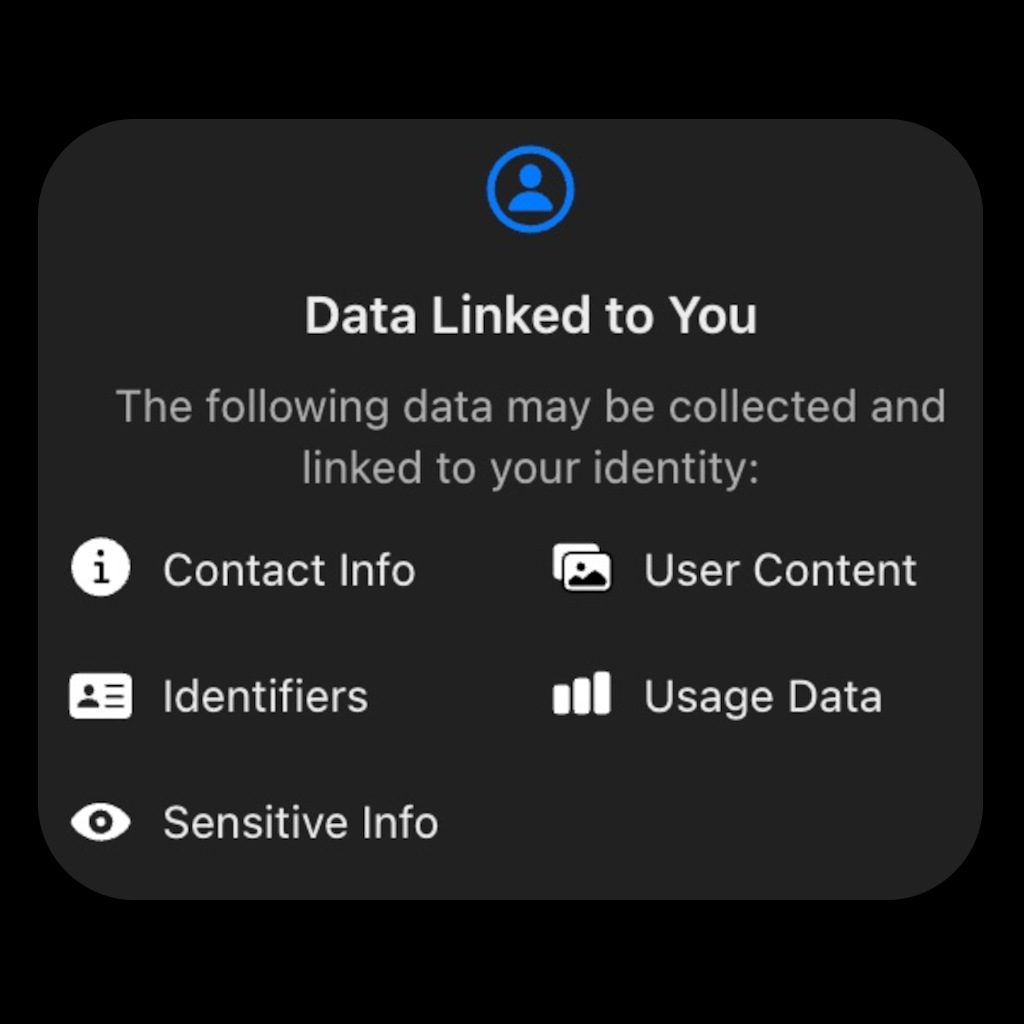
On the App Store, every app has to show a Privacy card. One section is called “Data Linked to You”, and it lists which kinds of data the developer (or their third-party partners) may collect and tie back to your identity.
Recently, we checked the privacy label of one of the most popular dream journaling apps. Its Data Linked to You section included:
- Contact Info
- User Content
- Identifiers
- Usage Data
- Sensitive Info
We are not naming the app. This is not about calling out one developer.
But if any dream journal app is collecting all of that, and explicitly linking it to you, it is worth slowing down and asking: why?
Let’s unpack what each of these categories usually means, and why combining them with third-party analytics or ad tech can quietly connect your dreams to a much bigger profile about you.
What “Data Linked to You” Really Means
On Apple’s side, “linked to you” means that data may be collected in a way that can be associated with your identity. That can be through your account, your device, or details like your name or email. The linkage can be direct (you log in) or indirect (stable identifiers across apps).
Here is what those categories generally cover in practice.
1. Contact Info
This often includes:
- Email address
- Phone number
- Physical address
- Other ways to reach you
In a dream app, this usually means you are creating an account, logging in, and possibly receiving marketing emails or notifications tied to that identity.
This alone isn’t necessarily concerning, but once your email or phone is in the mix, your dream data is no longer “just on your device.” It can be tied to you as a person in a database, and possibly shared with other tools or services the developer uses.
2. User Content
This category covers:
- Anything you directly enter: journal entries, notes, tags
- Uploaded media: audio logs, images, and so on
For a dream journal, this is the heart of it: your actual dreams.
When User Content is listed under Data Linked to You, it means those deeply personal entries may be associated with your identity or device and potentially processed alongside other linked data.
3. Identifiers
This usually includes:
- Device ID
- Advertising ID
- User ID or account ID
- Pseudo-anonymous IDs used to track you across sessions or services
Identifiers are the glue. They are what let a company (or their analytics provider) say things like:
“This is the same person who did X in our app, Y on our website, and Z in another app that uses the same analytics or ad SDK.”
If a dream app collects identifiers and uses a big third-party analytics or ad SDK, your dream-logging behavior can become just one more column in a much wider behavioral profile.
4. Usage Data
This typically covers things like:
- How often you open the app
- Which screens you use
- What features you interact with
- Rough session times and durations
Usage data is not automatically bad. Developers need some basic telemetry to make things work and improve the app.
The issue is who sees it, and what it is tied to. When usage data is:
- linked to your account or email, and
- sent to a third-party analytics service that is integrated across many apps,
then your dream journaling habits can be analyzed alongside your behavior across many other apps and services.
5. Sensitive Info
This category is a serious red flag in a dream context.
“Sensitive Info” is a broad bucket. It can include:
- Health information
- Sexual orientation or activity
- Sensitive psychological or emotional data
- Other categories Apple considers especially privacy-critical
Your dreams frequently touch exactly that: health anxieties, sexuality, trauma, self-harm themes, addiction, grief, and more. If that kind of content is being modeled, tagged, or inferred and then linked to identifiers and contact info, you are essentially contributing very sensitive psychological data to a system that may not be built with privacy-first design.
Why Third-Party Analytics Make This Worse
Even if a dream app “only” uses a popular analytics SDK, there are two quiet problems.
-
Cross-app tracking potential
If many apps send data to the same analytics provider, and they all share identifiers, that provider can build a cross-app profile of your behavior: fitness, productivity, shopping, dating, and yes, dreams. -
Data reuse outside the original context
Once your data is in someone else’s infrastructure, it may be used for aggregate analysis, machine learning, or other purposes that go beyond “make this one app better.” The privacy policy might allow broad “business purposes” that are hard to reason about as a normal user.
Individually, each data point feels harmless. Together, they can sketch a surprisingly detailed picture of your inner life.
How The Dream Drop Does Things Differently
The Dream Drop (and Root Code Collective, the nonprofit that operates it) exists precisely because we wanted the opposite kind of dream platform: privacy-first, research-oriented, and deliberately boring from a tracking perspective.
Here is what that looks like in practice.
1. No personal identifiers
We do not collect:
- Names or usernames
- Emails or phone numbers
- Physical mailing addresses
- Account passwords or logins
- Device IDs or advertising IDs
There is no “profile” to connect your dreams back to you as a person. You are represented in our system only by an internal, anonymized key that never gets shared with third parties.
2. No third-party trackers or ad SDKs
We do not embed:
- Advertising SDKs
- Cross-app analytics tools
- Social media pixels
- Third-party “engagement” SDKs that quietly track users
We run our own minimal, internal analytics where needed for reliability and research, and we keep it de-identified by design. There is no ad network watching what you dream about.
3. Approximate location only
We never store exact GPS coordinates.
Instead, we use approximate location (for example a city or postal-code region) to:
- help connect dreams by area, and
- support cross-cultural dream research.
This lets us study “people in Toronto versus people in São Paulo” without ever knowing who those people are or where their homes are.
4. Optional demographics, not required
Age, gender, and similar fields are:
- optional, and
- used only for anonymized research and aggregate stats, not for targeted ads or marketing.
You can use The Dream Drop without filling them out at all.
5. Operated by a nonprofit, not an ad-tech company
The Dream Drop is run by Root Code Collective, a U.S. 501(c)(3) public charity.
Our mission is:
- to support open, privacy-respecting dream research, and
- to provide a safe, anonymous place to log and explore dreams.
We survive through small donations, grants, and collaborations with universities, not by selling data profiles.
6. Control over your visibility
Inside the app, you can:
- Mark any individual dream as Private so it is never shared to the public dream feed.
- Request deletion of your data through a right-to-be-forgotten process if you decide you want to remove your contributions from the project.
A Quick Checklist for Any Dream App
Even if you never use The Dream Drop, here is a simple checklist you can apply to any dream journaling app before trusting it with your inner life.
-
Check the App Store privacy card
- How many categories are under “Data Linked to You”?
- Do you see User Content or Sensitive Info in that section?
-
Look for third-party analytics or ad SDKs
- Scan the privacy policy for names of ad networks, analytics providers, or “business partners.”
-
See what is required to get started
- Can you log dreams without creating an account?
- Is email or phone mandatory?
-
Watch for vague language
- Phrases like “for marketing purposes,” “improving our services,” or “business partners” can hide a lot of data movement behind the scenes.
If something feels off, trust that feeling. Your dreams don’t have to be disposable content. They are part of your psychological “source code.”
Why We Care So Much
From the beginning, we built The Dream Drop on a simple belief:
Your dreams are incredibly valuable for both you and science, but they should not become raw material for ad-tech.
We want more people to log more dreams, across more cultures and languages, so researchers can understand patterns that have never been visible before. But we want to do that without sacrificing your privacy or turning your inner world into another data product.
If that resonates with you, you are welcome in The Dream Drop community. If not, that is okay too. Just promise us one thing:
Before you hand your dreams to an app, check that privacy label.
Wishing you meaningful dreams,
The Dream Drop Team