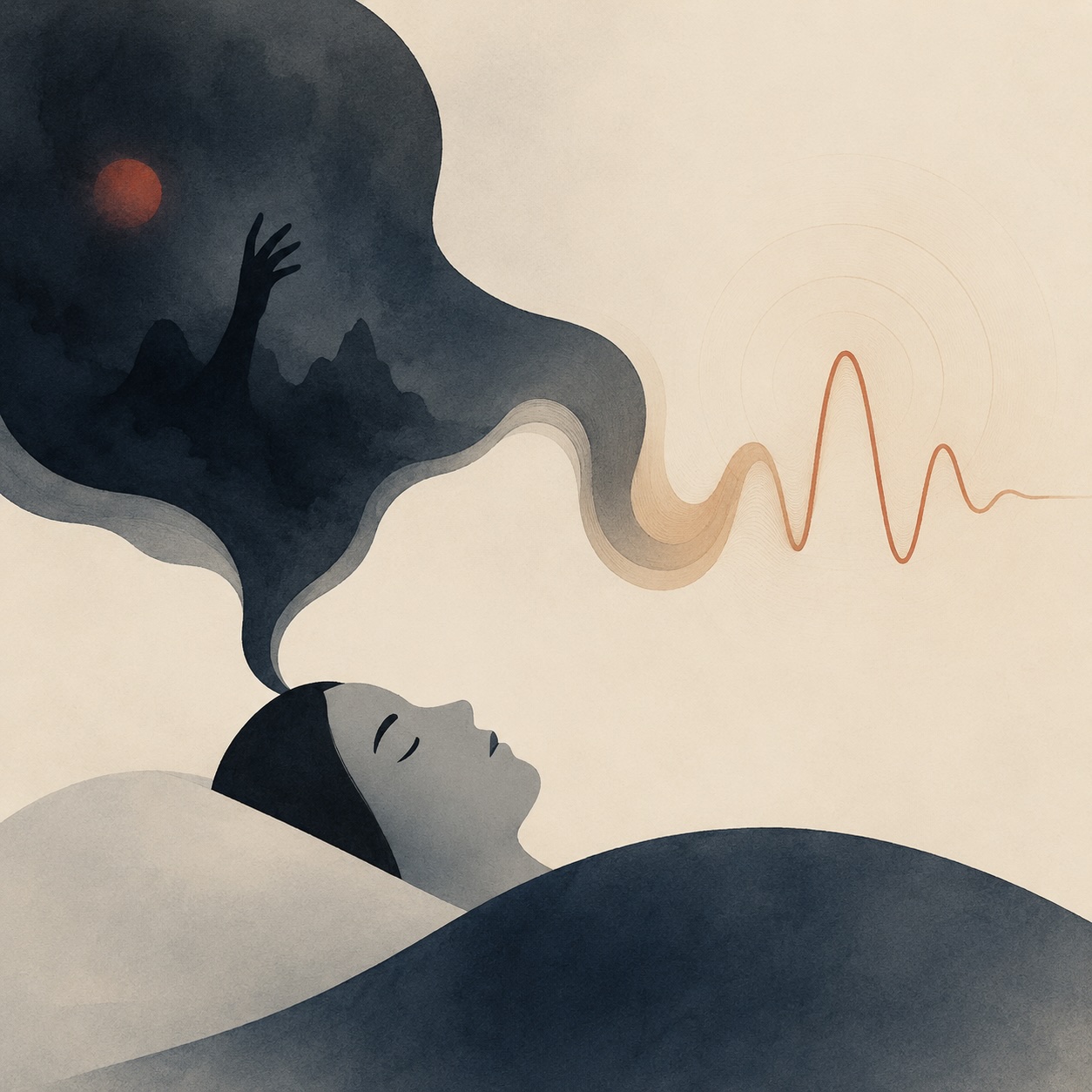
Many of us have heard that dreams help us process difficult emotions. A frightening dream, according to this idea, may give the sleeping brain a chance to rehearse fear in a safe environment, leaving us better prepared to handle it while awake.
It is an appealing explanation. A new study suggests the relationship may be more complicated.
In research published in the journal SLEEP, people who experienced more fear in their dreams showed stronger brain responses to negative images while awake, at least when they also reported generally good sleep. However, they did not appear to be any better at regulating those emotional responses.
The finding does not mean that frightening dreams make us more emotionally reactive. It does suggest that fear in dreams and emotional sensitivity during waking life may be connected in ways that cannot be explained by a simple overnight emotional reset.
Following Fear From Dreams Into the Lab
The researchers recruited 87 adults between the ages of 18 and 70.
For seven mornings, participants recorded their dreams and rated the emotions they remembered experiencing. They also reported how well they had slept.
After the week of dream reporting, the participants visited a laboratory, where they viewed a series of neutral and negative images while their brain activity was measured using electroencephalography, or EEG.
During some images, participants were asked to simply look and allow themselves to react naturally. During others, they were asked to reinterpret what they were seeing in a way that reduced its emotional impact.
This allowed the researchers to examine two related but different processes.
Emotional reactivity describes how strongly someone initially responds to something negative.
Emotional regulation describes how effectively someone can reduce or reshape that response.
The researchers examined both the participants’ descriptions of how they felt and a pattern in their brain activity called the late positive potential, or LPP. The LPP tends to become stronger when something emotionally significant captures a person’s attention.
What the Researchers Found
Participants who reported more fear across their week of dreams, along with relatively good sleep quality, showed stronger LPP responses when viewing negative images.
In other words, their brains appeared to respond more strongly to emotionally negative material.
Curiously, this difference did not appear in the participants’ own ratings. People with more fear in their dreams did not necessarily say that the images made them feel more emotional or aroused.
The relationship appeared in the brain activity, but not in their conscious descriptions of the experience.
The researchers also found no significant connection between fear in dreams and emotional regulation. People who experienced more dream fear were not clearly better at reducing their responses to negative images. They were not clearly worse at it either.
That distinction is important. Reacting strongly to an emotional event is not the same as being unable to regulate that reaction.
Why the Finding Is Surprising
The study tested two broad ways of thinking about emotional dreams.
The first is the continuity view. According to this idea, dreams reflect some of the same emotional tendencies we experience while awake. Someone who is particularly sensitive to fear during the day may also experience more fear while dreaming.
The second is the emotion regulation view. This proposes that experiencing difficult emotions in dreams helps the brain process them, potentially making the dreamer less reactive or better able to regulate those emotions while awake.
The new findings offered limited support for continuity. People who generally experienced more fear in their dreams also showed stronger waking brain responses to negative material.
The study did not, however, find evidence that experiencing more dream fear was connected to better emotional regulation.
This does not prove that dreams play no role in emotional processing. It only means that this particular study did not find the relationship that a straightforward emotion regulation theory might predict.
Sleep Quality Complicates the Picture
One of the most interesting findings involved sleep quality.
The connection between greater dream fear and stronger waking brain responses appeared among participants who generally reported good sleep.
Among those reporting poorer sleep, the pattern moved in the opposite direction. Greater dream fear was associated with a weaker neural response to negative images.
The researchers caution that the meaning of this difference is not yet clear. A weaker neural response does not necessarily indicate better emotional regulation. It could also reflect reduced attention, fatigue, or changes in emotional processing associated with disrupted sleep.
The finding does show that dream emotion cannot always be separated from the quality of the sleep surrounding it.
Two people may both report frightening dreams, but the experiences may relate differently to waking emotion if one slept soundly and the other had a restless or fragmented night.
What the Study Cannot Tell Us
The study found a relationship between average dream fear and waking brain responses across different people.
It did not show that having a frightening dream on a particular night changes how someone will respond the following day.
It also cannot tell us which direction the relationship runs. Dream fear might influence waking emotional sensitivity. Waking emotional sensitivity might shape dreams. Both could be influenced by other factors, including stress, personality, sleep patterns, or differences in dream recall.
The sample was also relatively small and uneven. Of the 87 participants, 76 were women, and the participants reported no psychiatric or sleep disorders. The findings therefore may not apply in the same way to everyone, particularly people experiencing frequent nightmares, trauma, anxiety, depression, or chronic sleep disruption.
More Question Than Answer
The study does not suggest that frightening dreams are harmful. It also does not rule out the possibility that some dreams help people work through emotional experiences.
Instead, it offers a more selective finding: fear in dreams appears to be connected to how strongly the brain responds to negative information while awake, but not necessarily to how well a person can consciously regulate that response.
For now, we do not know whether frightening dreams prepare us for fear, reflect an existing sensitivity to it, or perform different roles under different circumstances.
What the study does suggest is that the emotions we experience while dreaming belong to a larger emotional system, one that continues across the boundary between sleeping and waking.
Read the Research
Lin, E., Grassini, S., Railo, H., Strid, N., Revonsuo, A., and Sikka, P. (2026). “Fear in Dreams Predicts Stronger Affect Reactivity in Wakefulness.” SLEEP. Published July 22, 2026.