
Most lucid dreaming techniques put the hardest part at the worst possible moment. You are half asleep, it is four in the morning, and you are trying to do something deliberate with a mind that is winding down for the night.
MPAILD moves the learning into the day.
A memory palace is a place you can walk into, look around, and act in, while knowing the entire time that you are the one constructing it. Structurally, the experience closely resembles lucid dreaming: you are present inside a built world, aware that you are aware, calm and quietly in charge.
That similarity lets you practice a lucid-like state while awake: not merely the trigger for lucidity, but the qualities of the state itself.
MPAILD, or Memory Palace Assisted Induction of Lucid Dreaming, uses a familiar mental route, stocked with your own recent dream material, as the place to do that. Then you reactivate the same route briefly during a short wake-back-to-bed.
MPAILD was developed at Root Code Collective, a 501(c)(3) focused on dream and consciousness research, and is currently being tested through Lucidity Lab.
Want the one-page version? Download the MPAILD cheatsheet as a PDF for printing or a PNG for your phone.
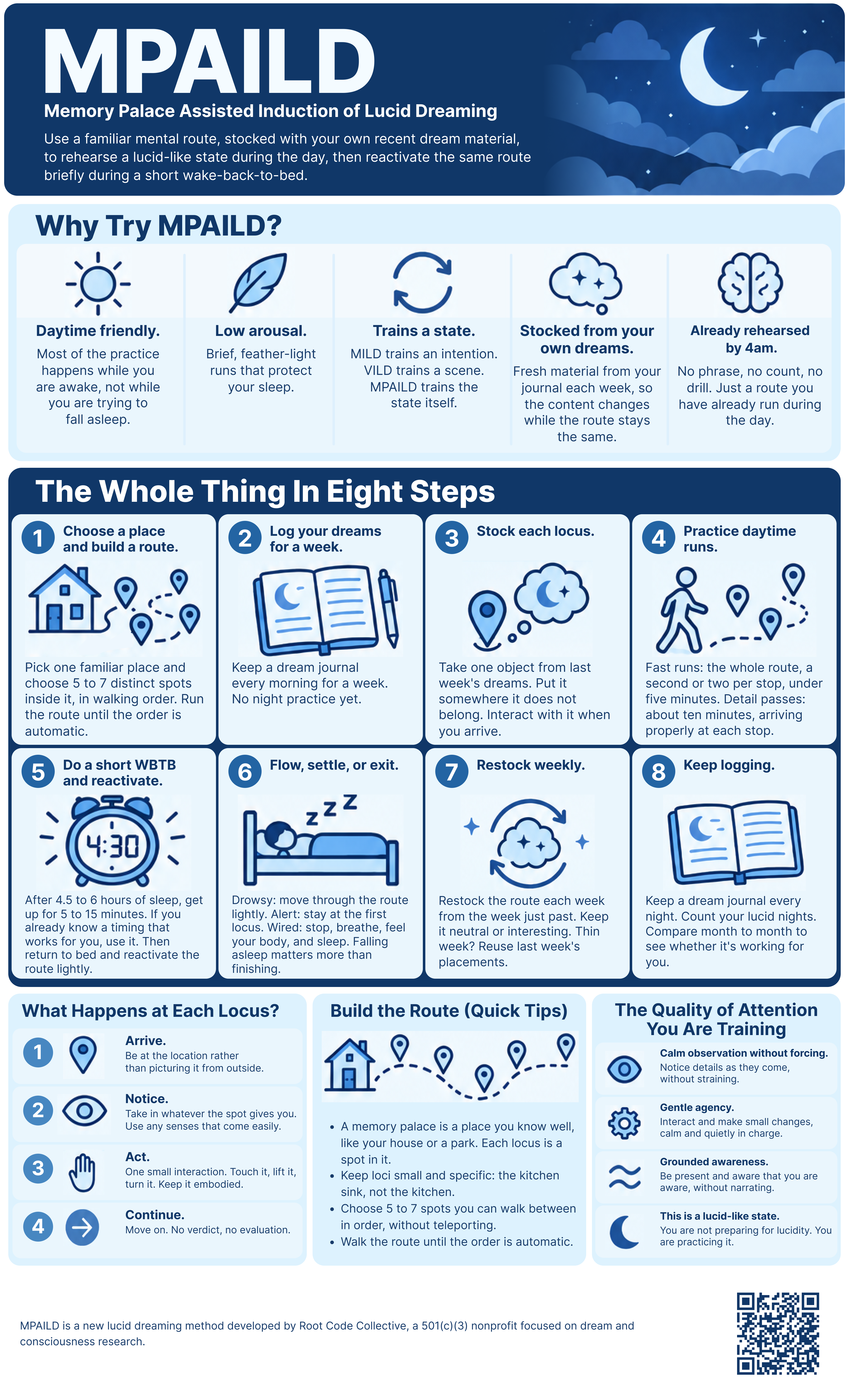
Why Try MPAILD
- Daytime friendly. Most of the practice happens while you are awake, not while you are trying to fall asleep.
- Low arousal. Brief, feather-light runs that protect your sleep.
- Trains a state. MILD trains an intention. VILD trains a scene. MPAILD trains the state itself.
- Stocked from your own dreams. The route is restocked every week from your journal, so you rehearse inside the content your dreams actually produce. The content changes while the route stays the same.
- Already rehearsed by 4am. No phrase, no count, no drill. Just a route you have already run during the day.
The Whole Thing In Eight Steps
- Pick one familiar place and choose 5 to 7 distinct spots inside it, in walking order. Run the route until the order is automatic.
- Log your dreams every morning for a week. No night practice yet.
- At the end of the week, stock each locus. Take one object from last week’s dreams, put it somewhere it does not belong, and interact with it when you arrive.
- Practice daytime runs. Fast runs cover the whole route at a second or two per stop, in under five minutes. Detail passes take about ten minutes, arriving properly at each stop. At every stop: arrive, notice, act, continue.
- After 4.5 to 6 hours of sleep, get up for 5 to 15 minutes. If you already know a WBTB timing that works for you, use it. Then return to bed and reactivate the route lightly.
- Flow, settle, or exit. If you are drowsy, move through the route lightly. If you are alert, stay at the first locus. If you are wired, stop, breathe, feel your body, and sleep. Falling asleep matters more than finishing.
- Restock the route each week from the week just past. Keep the material neutral or interesting. Thin week? Reuse last week’s placements.
- Keep a dream journal every night. Count your lucid nights and compare month to month to see whether it is working for you.
Build the Route
A memory palace is a single familiar place, and each locus is a specific spot along a route through it. Not a list of unrelated places. Your house is a palace; the front door, the kitchen counter, and the hallway closet are loci along a route through it. A park is a palace; the gate, the third bench, and the footbridge are loci along a walk through it. The test is whether you could physically walk from each spot to the next without teleporting.
Pick one place you know well and choose five to seven distinct spots inside it, in the order you would actually walk past them. Walk the route until the order is automatic. Nothing added to the spots yet. A day or two.
Keep the loci small and specific. “The kitchen” is an area with a dozen things in it and your attention will wander. “The kitchen sink” is a spot you can stand at.
Seven is the ceiling, not a starting point you grow out of. A longer route does not train anything a short one does not, it takes longer to run so you run it less often, and it needs more dream material every week than an ordinary journal will give you. Five is fine.
Log for a week. Keep a dream journal every morning. No night practice, no wake-back-to-bed, no MPAILD attempts. This week does three jobs: it establishes the recall habit every lucid dreaming method depends on, it gives you a personal baseline to measure against later, and it fills a buffer of dream material for the route.
At the end of the week, you will stock the route from the dreams you just logged and begin daytime practice.
Do not skip the logging week. Without recall you have nothing to stock the route with.
What You Are Actually Practicing
At each locus you do four things:
- Arrive. Be at the location rather than picturing it from outside.
- Notice. Take in whatever the spot gives you. Visual detail, texture, weight, temperature, sound, the feel of the air, the sense of the space around you. Use whatever comes easily. If you see things vividly, see them vividly. If you do not picture much at all, the other senses carry the practice perfectly well, and plenty of people work entirely without visuals.
- Act. One small interaction. Touch it, lift it, turn it. This is what keeps the practice embodied rather than a slideshow, and embodied is what makes it dream-like.
- Continue. Move on. No verdict, no evaluation.
Keep words out of it. If you catch yourself describing the locus to yourself, or narrating what you are doing there, you have slipped from being present into thinking about being present. Those are different, and only one of them is the practice. Drop the commentary and go back to the senses.
Underneath those four beats is the thing you are really training: a particular quality of attention.
- Calm observation without forcing. You notice details as they come, without straining or demanding that they appear.
- Gentle agency. You can interact and make small changes, but there is no urgency in it.
- Grounded awareness. You are present in the space, aware that you are aware, without getting pulled into narrative or thought-loops.
- Relaxed control. Like being a guest in your own mind: comfortable, curious, and quietly in charge.
Being aware that you are aware, while inside a constructed environment, doing things in it, staying calm, is structurally very close to being lucid. You are not preparing for the state. You are practicing it, in a place where it is available on demand.
Stocking Your Loci
Each locus holds one object from a recent dream, placed somewhere it does not belong.
The rule: Take something from last week’s dreams. Put it somewhere it does not belong. Interact with it when you arrive.
The wrongness of the placement is what makes the locus vivid and what keeps your attention from coasting. Your phone sitting on a park slide is not something you walk past.
Three tiers, depending on what your week gave you. You will always land on one of them.
Best. A dream object plus something it did in the dream, especially if it misbehaved. Last week you could not dial your phone, so the phone goes on the slide and dialing it is what you do there.
Usual. A dream object with nothing particular attached, plus whatever interaction it naturally affords. Your sister’s car appeared in Tuesday’s dream, so it goes in your kitchen and you open the door.
Fallback. Some weeks are thin, and some weeks produce dreams you would rather not rehearse. Use the locus’s own furniture with a simple interaction, or carry last week’s placements forward. This is not a failure and there is no penalty for it.
Two cautions. Pick material that feels neutral or interesting, never distressing. You will run these many times a day and nothing in your palace should be something you would rather avoid. And keep the objects as things you engage with rather than oddities you observe. The point is not to become comfortable around impossible things.
An Example Route
One park, walked in order. You come in at the parking lot entrance, pass the trail head sign, reach the first bench under the oak, then the drinking fountain, the playground swings, the picnic table by the pond, and finally the wooden footbridge. Seven spots, one continuous walk, always the same direction.
Stocked from a week of dreams: your work badge lying in the parking lot, pick it up and feel it in your hand. Your mother’s cat on the trail sign, call it over. A birthday cake on the bench, cut a slice. Your car keys in the fountain basin, lift them out. A phone hanging from the swing chain, take it down and swipe the screen. Your old laptop on the picnic table, open it. A garden hose along the bridge rail, turn it on.
None of these belong there. All of them give you something to do.
Two Kinds Of Daytime Run
Fast run. The whole route, a second or two per locus. Impressions rather than full scenes. The goal is familiarity with the route, not richness at each stop. Five minutes at most, and it fits in a queue or a walk.
Detail pass. The whole route at a slower pace, arriving properly at each stop. This is where the quality of attention actually develops. Ten minutes, and it is closer to meditation than to rehearsal.
Do fast runs often and make room for detail passes when you can. Fast runs keep the route familiar. Detail passes are where the state gets trained.
Night Protocol
Wake after roughly 4.5 to 6 hours of sleep. Start with 5 to 15 minutes awake. That range is a suggestion, not a rule. Increase or decrease it based on how easily you return to sleep, or use the WBTB timing that has worked best for you in the past.
While you are up, keep the lights low. If you remember a dream, jot down only enough to preserve it. Then return to bed.
Then pick one mode.
Flow. Start at locus 1 and move in order. Keep it feather-light. If drift deepens and the imagery starts running itself, that may be the transition into a dream. Hold the awareness but stop pushing yourself to the next locus. Sounds often begin layering into the imagery, or details appear that you did not supply. Let them come without chasing them.
Settle in. If you are more alert than drowsy, do not try to cover ground. Take the first locus and stay there. Notice what is around you, take your time, and let the next one arrive on its own if it wants to. If it never does, you have lost nothing. There is no count to keep and nothing to finish.
Whichever you pick, prioritize falling back asleep over completing the route.
Exit ramps
If you notice yourself getting wound up or too awake, exit softly. The work is already done. Your daytime practice is what trains the state, and the night session is only a light reactivation. Nothing has to happen tonight.
To exit: stop the route, take one breath, feel the weight of your body, and let yourself fall asleep.
Flow if flowing. Settle in if alertness rises. Exit if wired. Trust the preparation.
The Fresh Anchor
Once the route runs itself, there is one addition worth making.
When you wake for your session and you remember the dream you just came out of, use it. Take one object or figure from that dream and drop it into locus 1, replacing whatever is there for tonight. Then run the route as usual. Tomorrow it goes back to the way it was.
The reason to bother is that the dream you just left is the most available material you have. Your mind was working on it minutes ago, dream themes can recur across the night and across sleep stages, and it still carries whatever charge it had. Your weekly placements are well rehearsed but cold. This one is hot.
It costs nothing to learn, because the route and the habit of putting an object at a locus are already built. You are swapping one item into a slot, not doing something new while half asleep.
Locus 1 is the right slot for it because every night run starts there. In flow you meet the fresh material first and carry it forward. When you settle in, you stay parked on it, which is the best place to be parked.
Two conditions. Only when you actually remember a dream, and only if the material is neutral or interesting. If you woke from something unpleasant, run the route as it stands.
What Recognition Will Probably Look Like
You are not being trained to run a drill, so it helps to know what you are becoming alert to.
People often realize they are dreaming when something behaves differently than expected. Something impossible works, or something ordinary does not. You rise off the ground. The weapon has no effect. The phone will not dial. The door will not open.
These moments arrive attached to a feeling you already have access to, which is the frustration or surprise of something not behaving. That feeling is the opening.
In these moments, lucidity does not come from performing a reality check. It comes from being present enough to notice that something does not add up. That kind of presence is a capacity rather than a procedure, and it is what the daytime practice builds. You are not learning to run a test. You are becoming the kind of dreamer who is present when the dream stops behaving as expected.
When You Get There
A large share of lucid dreams end within seconds of recognition. Awareness arrives, excitement spikes, and the dream collapses. This is trainable, and the palace gives you a place to practice a calmer response.
Every detail pass is a chance to practice the response you want when lucidity arrives. Let the recognition land, then stay where you are. Look at your hands or the ground. Feel the floor. Take one slow, deliberate action. Continue through the route. The calm you have been practicing at every locus is the same calm you need when lucidity arrives.
The palace is also useful once you are lucid. It is the most rehearsed spatial content in your head, which makes it a natural place to go when a dream starts to fade. If stability drops, go to locus 1 rather than trying to hold the scene together. Arrive, notice what is there, and act on one object. Rebuilding from a known location can be easier than trying to rescue a scene that is slipping away.
One thing worth settling in advance: know what you want to do. Lucid dreams are short and deciding while you are in one burns most of what you have. Pick two or three things you would actually like to try, keep them in mind the way you keep a short list of errands, and change them when they stop interesting you. This is a daytime decision, not something to work out at four in the morning.
Common Mistakes
- Skipping the logging week and going straight to night practice.
- Building a longer route in the belief that more loci means more progress.
- Treating the odd object as scenery to observe rather than something to engage with.
- Stocking the route with distressing material.
- Narrating instead of keeping the experience sensory and light.
- Running long at night and becoming too awake.
- Straining for richer imagery than comes naturally. Effort is the enemy here, not a lack of detail.
- Expecting the method to work without solid dream recall underneath it.
- Using the fresh anchor before the basic route is automatic.
Reality Checks, And Where They Actually Belong
MPAILD does not use reality checks inside the palace. A reality check is meant to distinguish waking from dreaming, but inside a visualization you already know the answer and control the result. The check passes or fails because you imagined it that way. That makes it a rehearsed gesture rather than a genuine question.
There is also no strong evidence that reality checks alone reliably raise lucidity. They have been studied both separately and alongside other components, but their independent contribution remains unclear.
But there is one moment where a physical check earns its place, and it is not during practice. It is when you wake up.
False awakenings are common, especially after a wake-back-to-bed, and they are convincing. You get up, you write in your journal, you walk to the bathroom, and none of it is happening. So when you wake for your session, check once before you do anything else. Pinch your nose shut, close your mouth, and try to breathe in. Awake, you cannot. Dreaming, you often can.
The nose pinch works well here because it relies on physical sensation and requires nothing else to be present.
That is the whole of it: no checks in the palace, one check on waking.
How MPAILD Compares
Most induction methods ask you to perform the core technique at sleep onset: rehearse a phrase, cycle your attention, or hold awareness across the threshold. MPAILD moves most of the training into the day, leaving only a brief reactivation of a route you already know at night.
It also differs in what it trains. MILD trains an intention. VILD trains a scene. MPAILD trains a state, which is why no particular content has to appear in the dream for it to pay off.
FAQ
Do I need to be good at memory palaces? No. You need one place you know well and a handful of specific spots inside it that you can walk in order. This is not memory training.
Isn’t this just regular memory palace practice? No. In mnemonic work the loci exist so you can retrieve what you stored. Here the stored object is not something you are trying to remember. It is there to make the environment vivid, personal, and dream-like. The spatial structure is the same. The purpose is not.
What if I had a thin dream week? Use the fallback tier. Simple interactions with the locus’s own furniture, or carry last week’s placements forward. Thin weeks are normal and not a reason to stop.
Do I need vivid visuals? No. Some people picture things in detail and some barely picture anything, and the practice works either way. Noticing is the skill, not seeing. Work with whatever senses come easily to you.
Why no reality checks during practice? A check you author inside your own visualization is not a check. But do use one on waking, to catch false awakenings. See the section above.
Should I keep a dream journal? Yes, permanently. It provides your baseline, stocks your loci every week, and lets you tell whether the practice is doing anything.
Can I combine MPAILD with other methods? Yes, and some pair better than others. FILD is the natural partner, because it runs on finger movement rather than thought, so it sits underneath the route without competing for attention. SSILD works too. MILD is the awkward one: it wants you rehearsing a phrase at the same moment you are running a route, and the two pull against each other. If you want both, alternate nights rather than stacking them.
How To Tell If It Is Working
Count.
Your logging week gave you a first number, not a final rate: how many of those seven nights included lucidity. Keep counting the same way once practice begins, then compare fixed four-week blocks. Note which nights included an MPAILD attempt, whether you recalled a dream, and whether the night session delayed sleep. Dream memory is unreliable about frequency, and a couple of vivid lucid dreams can leave you convinced you are on a streak when the rate has not moved. The count settles it.
One thing not to mistake for progress. When the practice starts feeling effortless and almost meditative, that means the rehearsal is going well. It is a good sign and it is not the same as more lucid dreams.
The Practice Is The Point
Most induction techniques are purely instrumental. A night that does not produce a lucid dream leaves you with lost sleep and nothing else, so every failure costs you something. After enough of them, many people stop.
MPAILD is built differently. Each week you go back through your journal looking for objects to stock the route, which means rereading your dreams with attention rather than filing them away. Each day you practice being present inside a scene you are sensing, a capacity most people rarely use. The route ties these together, so MPAILD becomes something you return to, the way you return to meditation, rather than a procedure you perform.
That changes what a dry spell means. Even if it is not the fastest route to lucidity, MPAILD keeps you more engaged with your own dreams than any standard induction technique, and it gives you a practice worth doing on the nights nothing happens.
Who MPAILD Is Best For
MPAILD is a good fit for people who want a daytime-friendly practice structure, find it easy to mentally move through familiar places, find that more aggressive nighttime methods fragment their sleep, or want a practice rather than a technique. It requires a dream journal, and it rewards one.
A Note On Where This Stands
MPAILD is new. The structural similarity at its center is the method’s working claim: lucid-like awareness can be rehearsed inside a consciously constructed world. Lucidity Lab exists to find out whether that rehearsal produces more lucid dreams, for whom, and under what conditions.
If you try MPAILD, keep logging whether or not you become lucid. Record the baseline week, the practice period, and the nights when nothing happens. Those nights matter just as much as the successes. A method cannot be evaluated if it only hears from the people who got results.